
 MRI Scan
 CT Scan
 Health Checkups
 Ultrasound
 Lab Tests
 2D Echo
 ECG
ECG EEG
EEG ENMG/NCV
 Health Screening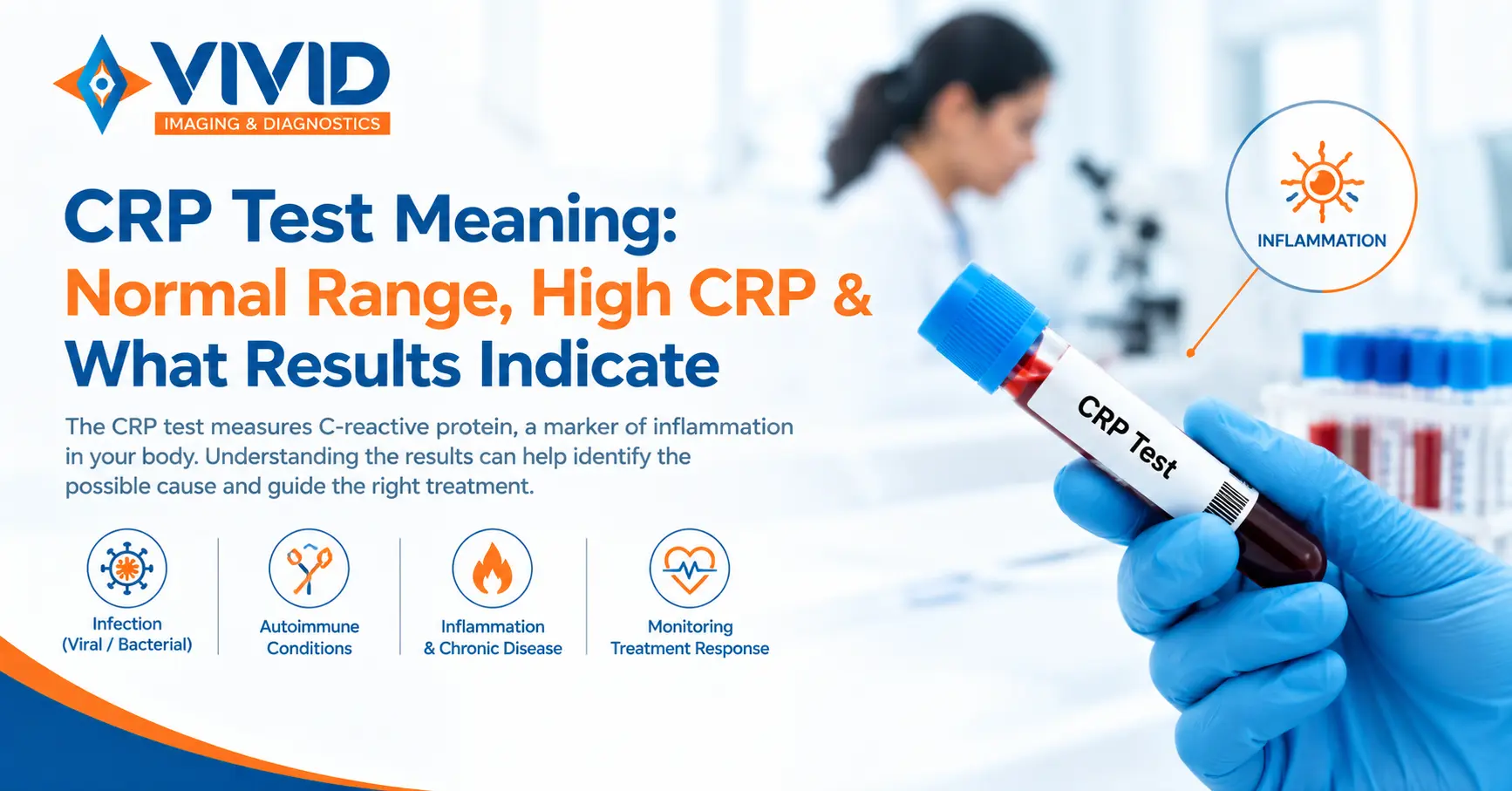
Table of Contents
- What Is the CRP Test?
- CRP Test Meaning in Simple Terms
- Why Is a CRP Test Done?
- What Does a CRP Test Measure?
- CRP Normal Range
- What Does High CRP Mean?
- Causes of High CRP Levels
- What Does Low CRP Mean?
- CRP Test and Infection
- CRP Test for Bacterial vs Viral Infection
- CRP Test and Other Blood Tests
- When Should You Get a CRP Test?
- How Is the CRP Test Performed?
- Does a CRP Test Require Fasting?
- CRP Test in Hyderabad
- Frequently Asked Questions
- Conclusion
What Is the CRP Test?
A CRP test is a blood test that measures the level of C-reactive protein (CRP) in the blood. CRP is produced mainly by the liver in response to inflammation in the body.
The CRP test meaning is therefore closely related to inflammation. When inflammation increases, CRP levels can rise. However, CRP does not usually identify the exact cause or location of inflammation on its own.
Doctors may use CRP testing along with symptoms, medical history, examination findings, and other laboratory or imaging tests to understand what may be happening in the body.
CRP Test Meaning in Simple Terms
In simple terms, the CRP test helps answer:
“Is there evidence of increased inflammation in the body?”
A higher-than-expected CRP level may occur with infections, inflammatory diseases, tissue injury, or other conditions.
Importantly, a high CRP does not automatically mean a person has a bacterial infection. Similarly, a normal CRP does not completely rule out infection or inflammation.
The result needs to be interpreted according to the person’s symptoms and clinical situation.
Why Is a CRP Test Done?
A CRP test may be requested when a healthcare professional needs additional information about inflammation or an inflammatory process.
Common reasons include:
- Persistent or unexplained fever
- Suspected infection
- Monitoring an inflammatory condition
- Monitoring response to treatment
- Suspected autoimmune or inflammatory disease
- Certain respiratory infections
- Evaluation of inflammation after injury or surgery
- Monitoring some chronic inflammatory conditions
CRP may also be repeated over time to see whether inflammation is increasing or decreasing.
What Does a CRP Test Measure?
The CRP test measures the concentration of C-reactive protein in the blood.
CRP is an acute-phase protein, meaning its concentration can increase relatively quickly when the body develops an inflammatory response.
However, CRP is a non-specific marker.
This means that CRP can indicate that inflammation is present but cannot independently tell you:
- Where the inflammation is occurring
- Exactly what caused it
- Whether the cause is bacterial, viral, autoimmune, or another condition
- How severe a particular disease is
For this reason, doctors interpret CRP together with other clinical information.
CRP Normal Range
There is no single CRP value that is appropriate for every laboratory or clinical situation. Reference ranges can vary depending on the laboratory method and the type of CRP test performed.
A standard CRP test is generally reported in mg/L.
A result within the laboratory’s stated reference range is generally considered not elevated. However, the meaning of a CRP result depends on the patient’s symptoms and reason for testing.
When reviewing your report, always check the reference range printed by the laboratory rather than comparing the number with an unrelated online range.
Important distinction: CRP vs hs-CRP
CRP and high-sensitivity CRP (hs-CRP) are related but are used for different clinical purposes.
- CRP: commonly used to assess inflammation associated with infections and inflammatory conditions.
- hs-CRP: designed to detect much smaller changes in CRP and may be used in specific cardiovascular risk assessment.
These tests should not be interpreted interchangeably.
What Does High CRP Mean?
A high CRP level generally means that there is increased inflammation somewhere in the body.
Possible causes include:
- Bacterial infections
- Viral infections
- Other infections
- Autoimmune or inflammatory disorders
- Tissue injury
- Certain chronic diseases
- Some cancers
- Obesity and metabolic inflammation
- Recent surgery or trauma
The degree of CRP elevation can provide useful information, but CRP alone cannot establish a diagnosis.
For example, two people can have elevated CRP for completely different reasons. One may have an infection, while another may have an inflammatory condition.
This is why a CRP result should be interpreted alongside symptoms and other investigations.
Causes of High CRP Levels
A raised CRP may be seen in many situations.
1. Infection
Infections can trigger an inflammatory response and increase CRP.
Depending on the symptoms, additional tests may be required to investigate conditions such as respiratory infections, urinary infections, dengue, malaria, or other infections.
2. Autoimmune and inflammatory conditions
Conditions involving abnormal or excessive inflammation may also increase CRP.
Examples include certain forms of:
- Rheumatoid arthritis
- Inflammatory bowel disease
- Vasculitis
- Other inflammatory disorders
3. Tissue injury
Trauma, burns, surgery, or other forms of tissue damage can increase inflammatory markers.
4. Chronic inflammation
Some long-term health conditions can be associated with persistent low-grade inflammation.
5. Other medical conditions
Certain cancers and other systemic conditions can also cause elevated CRP.
Therefore, high CRP should be viewed as a clinical clue rather than a diagnosis.
What Does Low CRP Mean?
A low or normal CRP generally suggests that there is no substantial systemic inflammatory response at the time of testing.
However, a normal result does not guarantee that there is no disease.
CRP can be affected by:
- The timing of the test
- The type and severity of the condition
- The individual’s immune response
- Whether inflammation is localized
- Other underlying factors
If symptoms continue despite a normal CRP, further medical evaluation may still be necessary.
CRP Test and Infection
One of the most common reasons doctors request a CRP test is to evaluate inflammation when infection is suspected.
For example, a person with fever may undergo a combination of investigations such as:
CRP + CBC + relevant infection-specific tests
The exact combination depends on the symptoms, duration of illness, age, medical history, and local disease patterns.
A CRP result can help provide additional information, but it should not be used by itself to diagnose an infection.
CRP Test for Bacterial vs Viral Infection
CRP can sometimes help clinicians assess the likelihood of different types of infection, but CRP alone cannot reliably distinguish bacterial infection from viral infection in every patient.
A higher CRP may occur with bacterial infections, but significant CRP elevation can also occur in other inflammatory conditions and some viral infections.
Similarly, a lower CRP does not completely exclude a bacterial infection.
Doctors may consider:
- Symptoms
- Duration of illness
- Physical examination
- CRP
- CBC
- Other inflammatory markers
- Culture or molecular testing
- Imaging where appropriate
This broader assessment provides more useful information than interpreting one number in isolation.
CRP Test and Other Blood Tests
CRP is often interpreted alongside other laboratory investigations.
| Test | What it can help assess |
|---|---|
| CRP | Inflammation |
| CBC | Red cells, white cells and platelets |
| ESR | Another marker of inflammation |
| Procalcitonin | May assist in selected suspected bacterial infections |
| Blood culture | Can identify certain bacteria in the bloodstream |
| Dengue tests | Detect dengue infection using appropriate tests and timing |
| Malaria tests | Investigate malaria infection |
| Urine tests | Help assess urinary infection and other urinary conditions |
The appropriate tests depend on the clinical situation.
When Should You Get a CRP Test?
A CRP test may be considered when symptoms suggest an inflammatory or infectious process.
Examples include:
- Fever without a clear cause
- Persistent fever
- Unexplained weakness with other symptoms
- Symptoms suggesting infection
- Monitoring a known inflammatory condition
- Checking response to treatment when clinically appropriate
You should not assume that every fever requires a CRP test. Test selection should be based on the patient’s symptoms and medical assessment.
How Is the CRP Test Performed?
The CRP test is a simple blood test.
A healthcare professional collects a small blood sample from a vein, usually from the arm. The sample is then processed in a laboratory and the CRP concentration is reported.
The report generally includes:
- CRP result
- Unit of measurement
- Laboratory reference range
Your healthcare professional can interpret the result in relation to your symptoms and other findings.
Does a CRP Test Require Fasting?
Usually, fasting is not required for a standard CRP blood test.
However, if your doctor has ordered CRP along with other blood tests, you may be asked to fast because of those additional tests.
Follow the preparation instructions provided by your healthcare provider or diagnostic laboratory.
CRP Test in Hyderabad
If you are searching for a CRP Test in Hyderabad, choosing a diagnostic laboratory with appropriate sample collection, laboratory processing, and reporting procedures is important.
For patients in Chandanagar and surrounding areas of Hyderabad, Vivid Imaging & Diagnostics provides laboratory diagnostic services, including blood testing.
The CRP test may be performed as an individual investigation or as part of a broader evaluation, depending on the clinical requirement.
For fever-related concerns, CRP may sometimes be requested alongside tests such as CBC, dengue testing, malaria testing, or other investigations based on symptoms and medical advice.
Frequently Asked Questions
What is the CRP test meaning?
The CRP test measures the amount of C-reactive protein in the blood. It is mainly used as a marker of inflammation and can help doctors assess inflammatory or infectious conditions.
What does a high CRP level mean?
A high CRP generally indicates increased inflammation. It may occur with infections, inflammatory diseases, tissue injury, and several other conditions. A high CRP alone cannot identify the exact cause.
Is CRP a test for infection?
CRP can provide useful information when infection is suspected, but it is not an infection-specific test. Additional tests may be required to determine the cause.
Can CRP distinguish bacterial and viral infections?
CRP may provide supporting information, but it cannot reliably distinguish bacterial from viral infections on its own. Clinical assessment and other tests are often needed.
Does CRP require fasting?
A standard CRP blood test usually does not require fasting. If CRP is ordered along with other tests, fasting may be required for those tests.
What is the difference between CRP and hs-CRP?
CRP is commonly used to assess inflammation, while hs-CRP measures smaller CRP changes and is used in specific clinical contexts, including certain cardiovascular risk assessments.
Can CRP be normal when I have an infection?
Yes. CRP may be normal during an early stage of illness or in some infections and clinical situations. A normal CRP does not completely rule out infection.
Is CRP included in a Fever Profile Test?
It can be. Fever Profile panels vary between laboratories and are not universally standardized. A fever evaluation may include CRP along with CBC and infection-specific tests depending on symptoms and medical advice.
Conclusion
Understanding the CRP test meaning is important when interpreting a blood report. CRP is primarily a marker of inflammation and can increase with infections, inflammatory diseases, tissue injury, and other conditions.
A high CRP does not automatically identify the cause of inflammation, and a normal CRP does not completely rule out disease. The result should therefore be interpreted alongside symptoms, examination findings, medical history, and other appropriate tests.
If you have persistent fever, worsening symptoms, breathing difficulty, severe weakness, confusion, dehydration, significant bleeding, or other concerning symptoms, seek medical evaluation promptly rather than relying on a CRP result alone.