
 MRI Scan
 CT Scan
 Health Checkups
 Ultrasound
 Lab Tests
 2D Echo
 ECG
ECG EEG
EEG ENMG/NCV
 Health Screening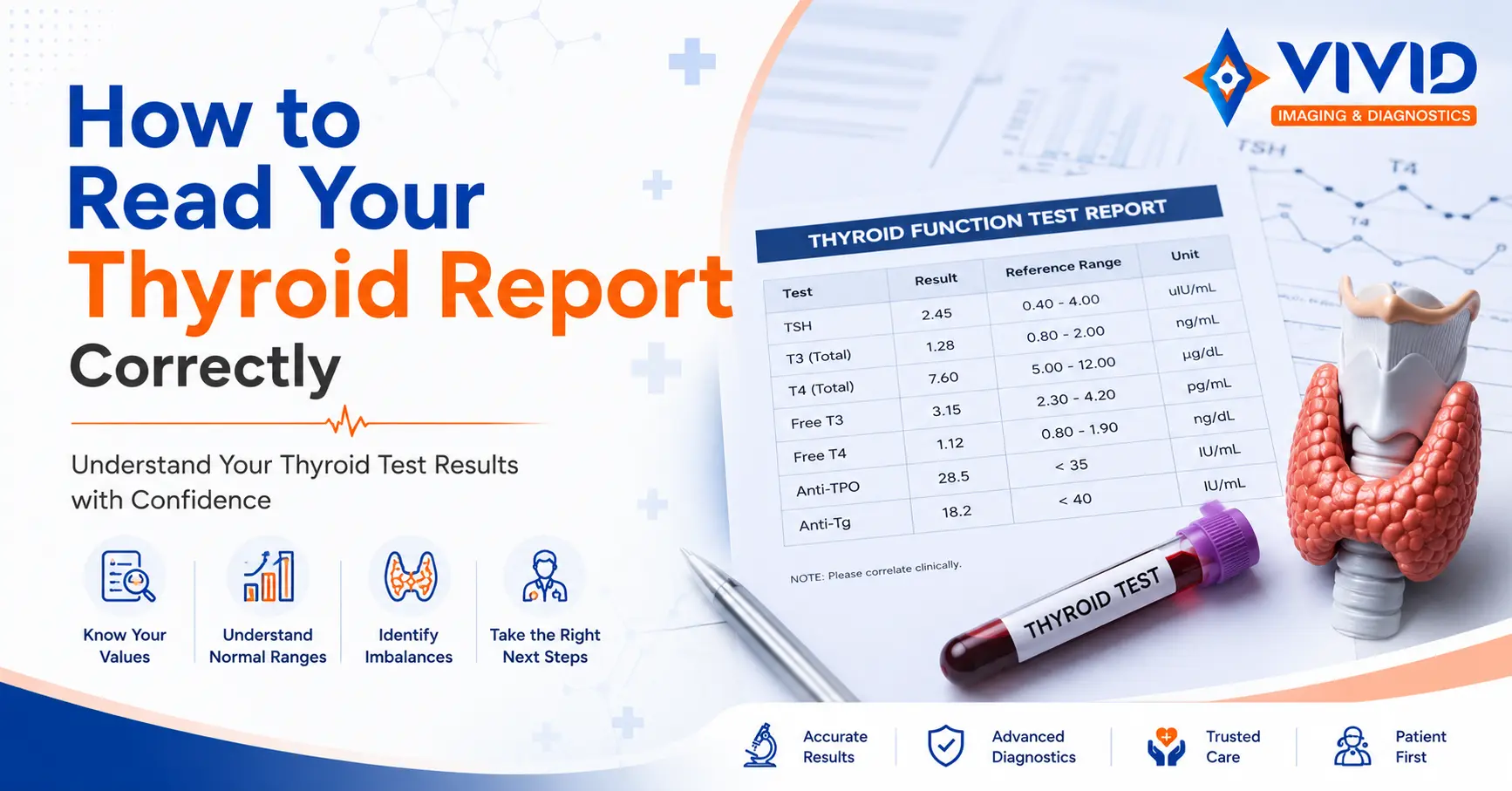
Table of Contents
- What Is a Thyroid Function Test?
- Why Understanding Thyroid Report Meaning Is Important
- Components of a Thyroid Report
- TSH Meaning in Thyroid Report
- Free T3 Meaning
- Free T4 Meaning
- Understanding Different Thyroid Report Combinations
- What Are Thyroid Antibody Tests?
- Normal Thyroid Levels in India
- Symptoms That May Require a Thyroid Test
- Factors That Can Affect Your Thyroid Report
- Can Thyroid Levels Change Over Time?
- How Often Should You Get a Thyroid Test?
- Tips for Reading Your Thyroid Report Correctly
- When Should You Consult a Doctor?
- Get Accurate Thyroid Testing at Vivid Imaging & Diagnostics
- Frequently Asked Questions
Have you recently received your thyroid blood test results but aren’t sure what the numbers mean? You’re not alone. Many people search for the thyroid report meaning after seeing terms like TSH, Free T3, Free T4, or Anti-TPO on their lab report.
Understanding your thyroid report is essential because it helps identify whether your thyroid gland is functioning normally or if there may be conditions such as hypothyroidism, hyperthyroidism, or autoimmune thyroid disease.
In this guide, you’ll learn how to read your thyroid report correctly, what each parameter means, normal thyroid levels in India, common thyroid disorders, and when you should consult a doctor.
What Is a Thyroid Function Test?
A thyroid function test (TFT) is a group of blood tests used to evaluate how well your thyroid gland is working. The thyroid is a butterfly-shaped gland located at the front of your neck. It produces hormones that regulate metabolism, body temperature, heart rate, energy production, growth, and brain function.
Doctors usually recommend thyroid testing if you have symptoms such as:
- Constant tiredness
- Weight gain or unexplained weight loss
- Hair fall
- Dry skin
- Anxiety
- Depression
- Irregular menstrual cycles
- Difficulty sleeping
- Swelling in the neck
- Fast or slow heartbeat
Why Understanding Thyroid Report Meaning Is Important
Many people only look at whether their report says “Normal” or “Abnormal.”
However, understanding the actual values can help you:
- Know whether your thyroid is underactive or overactive
- Monitor ongoing thyroid treatment
- Detect thyroid problems early
- Understand why your doctor recommends medication
- Track improvement over time
Your thyroid report usually contains multiple parameters that work together rather than one single value.
Components of a Thyroid Report
A standard thyroid profile generally includes:
- TSH
- Free T3 (FT3)
- Free T4 (FT4)
Sometimes your doctor may also recommend:
- Total T3
- Total T4
- Anti-TPO Antibody
- Thyroglobulin Antibody
- TSH Receptor Antibody (TRAb)
Let’s understand each one.
TSH Meaning in Thyroid Report
TSH stands for Thyroid Stimulating Hormone.
It is produced by the pituitary gland in the brain rather than the thyroid itself.
Its job is to tell your thyroid how much hormone to produce.
Think of TSH as the manager controlling your thyroid gland.
If thyroid hormone levels are low, the pituitary releases more TSH.
If thyroid hormones are high, it reduces TSH production.
Because of this relationship, TSH is often considered the most important thyroid test.
Normal TSH Range
The typical reference range for adults is:
0.4–4.0 mIU/L
Different laboratories may have slightly different reference ranges.
High TSH Means
A high TSH usually indicates:
- Hypothyroidism
- Underactive thyroid
- Hashimoto’s thyroiditis
- Poor response to thyroid medication
Common symptoms include:
- Weight gain
- Fatigue
- Hair loss
- Dry skin
- Cold intolerance
- Constipation
- Depression
Low TSH Means
A low TSH generally suggests:
- Hyperthyroidism
- Overactive thyroid
- Graves’ disease
- Excess thyroid medication
Symptoms may include:
- Weight loss
- Anxiety
- Sweating
- Tremors
- Rapid heartbeat
- Difficulty sleeping
Free T3 Meaning
Free T3 is the active thyroid hormone that affects almost every organ in the body.
It controls:
- Metabolism
- Energy production
- Heart rate
- Digestion
- Body temperature
Normal Free T3 Range
Generally:
2.3–4.2 pg/mL
Reference values vary between laboratories.
High Free T3
High FT3 may indicate:
- Hyperthyroidism
- Graves’ disease
- Toxic thyroid nodules
Low Free T3
Low FT3 can occur in:
- Hypothyroidism
- Severe illness
- Nutritional deficiencies
- Recovery from major illness
Free T4 Meaning
Free T4 is the inactive thyroid hormone that later converts into T3 inside body tissues.
It reflects how much hormone your thyroid gland is producing.
Normal Free T4 Range
Usually:
0.8–1.8 ng/dL
Again, ranges differ slightly among laboratories.
High FT4
High FT4 commonly suggests:
- Hyperthyroidism
- Graves’ disease
- Excess thyroid medication
Low FT4
Low FT4 usually indicates:
- Hypothyroidism
- Pituitary disorders
- Chronic thyroid disease
Understanding Different Thyroid Report Combinations
High TSH + Low T4
This usually indicates:
Primary Hypothyroidism
The thyroid gland isn’t producing enough hormones.
Low TSH + High T4
Usually indicates:
Hyperthyroidism
The thyroid is producing excessive hormones.
High TSH + Normal T4
Often called:
Subclinical Hypothyroidism
This is an early stage of hypothyroidism.
Low TSH + Normal T4
May suggest:
Subclinical Hyperthyroidism
Patients often have mild or no symptoms.
Normal TSH + Normal T3 + Normal T4
This generally indicates:
Healthy thyroid function.
What Are Thyroid Antibody Tests?
Sometimes thyroid problems occur because the immune system attacks the thyroid gland.
Doctors may order antibody tests such as:
Anti-TPO Antibody
High levels commonly indicate:
- Hashimoto’s thyroiditis
- Autoimmune hypothyroidism
TSH Receptor Antibody (TRAb)
Positive TRAb is commonly seen in:
- Graves’ disease
Thyroglobulin Antibody
Often used to diagnose autoimmune thyroid disorders and monitor thyroid cancer treatment.
Normal Thyroid Levels in India
Although reference ranges vary slightly, many Indian diagnostic laboratories use values close to:
| Test | Normal Range |
| TSH | 0.4–4.0 mIU/L |
| Free T3 | 2.3–4.2 pg/mL |
| Free T4 | 0.8–1.8 ng/dL |
Always interpret results using your laboratory’s reference range.
Symptoms That May Require a Thyroid Test
Your doctor may recommend thyroid testing if you experience:
- Constant fatigue
- Sudden weight gain
- Unexplained weight loss
- Hair thinning
- Dry skin
- Mood changes
- Anxiety
- Depression
- Irregular periods
- Fertility problems
- Neck swelling
- Difficulty concentrating
- Slow heartbeat
- Fast heartbeat
Factors That Can Affect Your Thyroid Report
Several factors can influence thyroid test results, including:
- Pregnancy
- Certain medications
- Recent illness
- Steroid use
- Biotin supplements
- Autoimmune diseases
- Age
- Stress
- Laboratory reference ranges
Inform your doctor about any medications or supplements before testing.
Can Thyroid Levels Change Over Time?
Yes.
Thyroid hormone levels can fluctuate due to:
- Pregnancy
- Ageing
- Autoimmune thyroid disease
- Changes in medication dosage
- Lifestyle changes
- Stress
- Iodine intake
People with diagnosed thyroid disorders often require periodic monitoring.
How Often Should You Get a Thyroid Test?
Testing frequency depends on your health condition.
Generally:
- Healthy adults with symptoms: As advised by a doctor
- Patients on thyroid medication: Every 6–12 weeks after dose changes, then every 6–12 months
- Pregnant women with thyroid disease: More frequent monitoring
- Individuals with autoimmune thyroid disease: Regular follow-up as recommended
Tips for Reading Your Thyroid Report Correctly
Keep these points in mind:
- Don’t interpret one value alone.
- Compare TSH, T3, and T4 together.
- Check your laboratory’s reference range.
- Don’t self-medicate based on online information.
- Consult an endocrinologist or physician for interpretation.
- Compare current results with previous reports to identify trends.
When Should You Consult a Doctor?
Seek medical advice if:
- Your TSH is outside the normal range.
- You have persistent thyroid-related symptoms.
- You’re pregnant and have abnormal thyroid results.
- You have a family history of thyroid disease.
- You notice a lump or swelling in your neck.
- Your symptoms continue despite treatment.
Early diagnosis and timely treatment can help prevent complications.
Get Accurate Thyroid Testing at Vivid Imaging & Diagnostics
If you’re looking for reliable thyroid testing in Hyderabad, Vivid Imaging & Diagnostics offers accurate thyroid function tests using advanced laboratory technology. Our experienced team ensures precise reporting with quick turnaround times to help doctors make informed treatment decisions.
We provide comprehensive thyroid profiles, home sample collection (where available), and timely reports to support your healthcare journey.
Book Your Thyroid Test Today
📍 Vivid Imaging & Diagnostics, Chandanagar, Hyderabad
📞 +91 90148 68655 | +91 93909 64532
🌐 www.vividdiagnostics.in
Frequently Asked Questions
What does a thyroid report show?
A thyroid report measures hormones such as TSH, Free T3, and Free T4 to determine whether your thyroid gland is functioning normally.
Which value is most important in a thyroid report?
TSH is generally considered the primary screening test, but doctors interpret it alongside Free T3 and Free T4 for an accurate diagnosis.
Can I have normal TSH but still have thyroid disease?
Yes. Some people may have early thyroid disease or autoimmune thyroid conditions despite having a normal TSH. Additional tests may be required based on symptoms.
Is fasting required for a thyroid test?
Fasting is usually not necessary for routine thyroid function tests unless your doctor recommends other fasting blood tests at the same time.
Can stress affect thyroid test results?
Severe stress and acute illness can influence thyroid hormone levels temporarily, so your doctor will interpret the results in the context of your overall health.
Can thyroid disorders be treated?
Yes. Most thyroid disorders can be effectively managed with medication, lifestyle changes, and regular follow-up testing.