
 MRI Scan
 CT Scan
 Health Checkups
 Ultrasound
 Lab Tests
 2D Echo
 ECG
ECG EEG
EEG ENMG/NCV
 Health Screening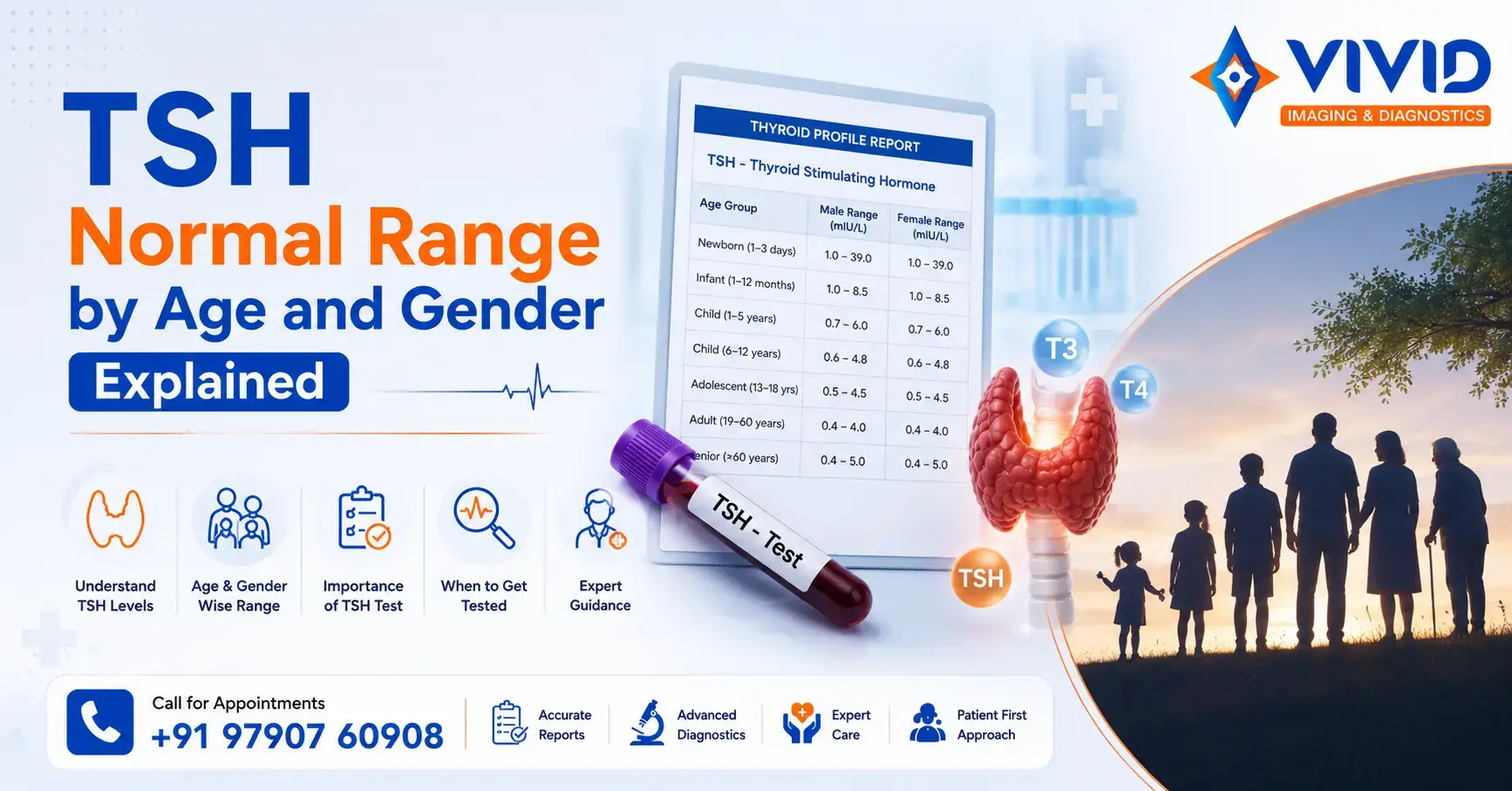
Table of Contents
- What Is TSH?
- Why Is TSH Important for Thyroid Health?
- TSH Normal Range Explained
- TSH Normal Range by Age
- TSH Normal Range by Gender
- TSH Normal Range During Pregnancy
- What Does a High TSH Level Mean?
- What Does a Low TSH Level Mean?
- Common Symptoms of Abnormal TSH Levels
- Causes of High TSH Levels
- Causes of Low TSH Levels
- When Should You Get a TSH Test?
- Which Tests Are Done Along With TSH?
- Understanding Your Thyroid Test Report
- Why Choose Vivid Diagnostics?
- Frequently Asked Questions
- Conclusion
Thyroid health plays a crucial role in regulating metabolism, energy levels, heart function, body temperature, and overall well-being. One of the most important laboratory tests used to evaluate thyroid function is the TSH test.
If you’ve recently received a thyroid test report, you may be wondering whether your results fall within the TSH normal range and what those numbers actually mean.
Understanding the TSH normal range by age and gender can help you interpret your results more accurately and identify when further medical evaluation may be needed.
What Is TSH?
TSH stands for Thyroid Stimulating Hormone, a hormone produced by the pituitary gland located at the base of the brain.
TSH acts as a messenger between the brain and the thyroid gland. Its primary function is to signal the thyroid to produce two essential hormones:
- T3 (Triiodothyronine)
- T4 (Thyroxine)
These hormones regulate many important body functions, including:
- Metabolism
- Energy production
- Heart rate
- Body temperature
- Weight management
- Mood and mental health
Why Is TSH Important for Thyroid Health?
The thyroid gland must maintain a delicate hormonal balance.
When thyroid hormone levels fall, the pituitary gland releases more TSH to stimulate the thyroid.
When thyroid hormone levels become too high, TSH production decreases.
Because of this feedback mechanism, TSH is often the first test used to identify thyroid disorders.
TSH Normal Range Explained
The TSH normal range for most healthy adults typically falls between:
| TSH Level | Interpretation |
| 0.4 – 4.0 mIU/L | Normal |
| Above 4.0 mIU/L | May indicate hypothyroidism |
| Below 0.4 mIU/L | May indicate hyperthyroidism |
It’s important to note that reference ranges may vary slightly between laboratories.
A result outside the TSH normal range does not always mean a thyroid disorder is present. Doctors interpret results alongside symptoms, age, medical history, and additional thyroid tests.
TSH Normal Range by Age
TSH levels naturally change throughout life.
TSH Normal Range in Children
Children generally have slightly higher TSH levels than adults because of growth and development requirements.
TSH Normal Range in Adults
Most adults fall within the standard TSH normal range of 0.4 to 4.0 mIU/L.
TSH Normal Range in Older Adults
Older adults may experience slightly higher TSH levels without having significant thyroid disease.
Age-related changes can influence thyroid hormone regulation, making clinical interpretation important.
TSH Normal Range by Gender
Although the overall TSH normal range is similar for men and women, women are significantly more likely to develop thyroid disorders.
TSH Normal Range in Women
Women frequently undergo thyroid testing because hormonal changes can affect thyroid function during:
- Menstruation
- Pregnancy
- Postpartum period
- Menopause
Women are more likely to experience hypothyroidism and autoimmune thyroid disorders.
TSH Normal Range in Men
Men generally have a lower risk of thyroid disease, but abnormal TSH levels can still occur and require evaluation.
TSH Normal Range During Pregnancy
Pregnancy causes significant hormonal changes that affect thyroid function.
For this reason, pregnancy-specific TSH targets are often used.
Maintaining an appropriate TSH level during pregnancy is important because thyroid hormones play a critical role in fetal growth and brain development.
Pregnant women with abnormal TSH levels should follow their healthcare provider’s recommendations for monitoring and treatment.
What Does a High TSH Level Mean?
A high TSH level often indicates that the thyroid gland is not producing enough thyroid hormones.
This condition is known as hypothyroidism.
Common Symptoms of High TSH
- Fatigue
- Weight gain
- Dry skin
- Hair loss
- Constipation
- Depression
- Cold intolerance
- Slow heart rate
- Puffy face
The pituitary gland increases TSH production in an attempt to stimulate the underactive thyroid.
What Does a Low TSH Level Mean?
A low TSH level often suggests that the thyroid gland is producing excessive thyroid hormones.
This condition is known as hyperthyroidism.
Common Symptoms of Low TSH
- Weight loss
- Anxiety
- Nervousness
- Rapid heartbeat
- Excessive sweating
- Tremors
- Difficulty sleeping
- Increased appetite
In this situation, the pituitary gland reduces TSH production because thyroid hormone levels are already elevated.
Common Symptoms of Abnormal TSH Levels
Symptoms vary depending on whether TSH is above or below the normal range.
Symptoms Associated With High TSH
- Constant fatigue
- Weight gain
- Memory problems
- Hair thinning
- Dry skin
- Feeling cold
Symptoms Associated With Low TSH
- Rapid heartbeat
- Excessive sweating
- Weight loss
- Anxiety
- Sleep disturbances
- Irritability
Causes of High TSH Levels
Several conditions can increase TSH levels.
Hypothyroidism
The most common cause of elevated TSH.
Hashimoto’s Thyroiditis
An autoimmune condition that damages the thyroid gland.
Iodine Deficiency
Inadequate iodine intake can impair thyroid hormone production.
Thyroid Surgery
Partial or complete removal of the thyroid can affect hormone production.
Certain Medications
Some medications may influence thyroid function and TSH levels.
Causes of Low TSH Levels
Hyperthyroidism
An overactive thyroid gland is the most common cause.
Graves’ Disease
An autoimmune disorder that causes excessive thyroid hormone production.
Thyroid Nodules
Overactive thyroid nodules can increase hormone secretion.
Excess Thyroid Medication
Taking excessive thyroid hormone replacement may suppress TSH levels.
When Should You Get a TSH Test?
You should consider thyroid testing if you experience:
- Unexplained fatigue
- Weight gain or weight loss
- Hair fall
- Mood changes
- Irregular menstrual cycles
- Infertility concerns
- Persistent constipation
- Heart palpitations
- Family history of thyroid disease
Thyroid Screening May Also Be Recommended For:
- Pregnant women
- Individuals with autoimmune diseases
- Older adults
- People with diabetes
- Those with previous thyroid disorders
Which Tests Are Done Along With TSH?
TSH is often evaluated alongside other thyroid function tests.
Free T3 Test
Measures active thyroid hormone levels.
Free T4 Test
Helps assess thyroid gland function.
Thyroid Antibody Tests
Used when autoimmune thyroid disease is suspected.
Thyroid Ultrasound
Recommended for thyroid enlargement or nodules.
Understanding Your Thyroid Test Report
A TSH result should never be interpreted in isolation.
Doctors often consider:
- TSH levels
- Free T3 levels
- Free T4 levels
- Symptoms
- Age
- Pregnancy status
- Medical history
This comprehensive evaluation helps determine whether thyroid treatment is necessary.
Why Choose Vivid Diagnostics for Thyroid Testing?
At Vivid Diagnostics, we provide comprehensive thyroid testing services to help patients understand their thyroid health accurately.
Our diagnostic services include:
- TSH Testing
- Free T3 Test
- Free T4 Test
- Thyroid Profile Testing
- Thyroid Antibody Testing
- Comprehensive Health Checkups
Using advanced laboratory technology and quality-focused testing standards, Vivid Diagnostics delivers accurate and timely reports to support better healthcare decisions.
Whether you are experiencing symptoms of thyroid imbalance or simply want to monitor your thyroid health, our team is committed to providing reliable diagnostic solutions.
Frequently Asked Questions About TSH Normal Range
What is the normal TSH range?
The TSH normal range for most adults is generally between 0.4 and 4.0 mIU/L.
Can TSH levels change with age?
Yes. TSH levels may gradually change with age, especially in older adults.
Is a high TSH level always hypothyroidism?
Not always. Additional thyroid tests are often required to confirm the diagnosis.
Can stress affect TSH levels?
Severe stress and illness may temporarily influence thyroid function and TSH results.
Should TSH be tested on an empty stomach?
Fasting is generally not required for a TSH test unless advised by your healthcare provider.
How often should thyroid testing be done?
Testing frequency depends on symptoms, medical history, treatment status, and medical recommendations.
Conclusion
Understanding the TSH normal range is essential for evaluating thyroid health and identifying potential thyroid disorders early. While the standard TSH normal range for adults is typically between 0.4 and 4.0 mIU/L, age, gender, pregnancy, and overall health can influence thyroid function and test interpretation.
If you are experiencing fatigue, unexplained weight changes, hair loss, mood changes, or other thyroid-related symptoms, timely thyroid testing can provide valuable insights into your health.
At Vivid Diagnostics, we offer comprehensive thyroid testing services, including TSH, Free T3, and Free T4 tests, helping you gain accurate information about your thyroid health and take the right next steps toward better well-being.